
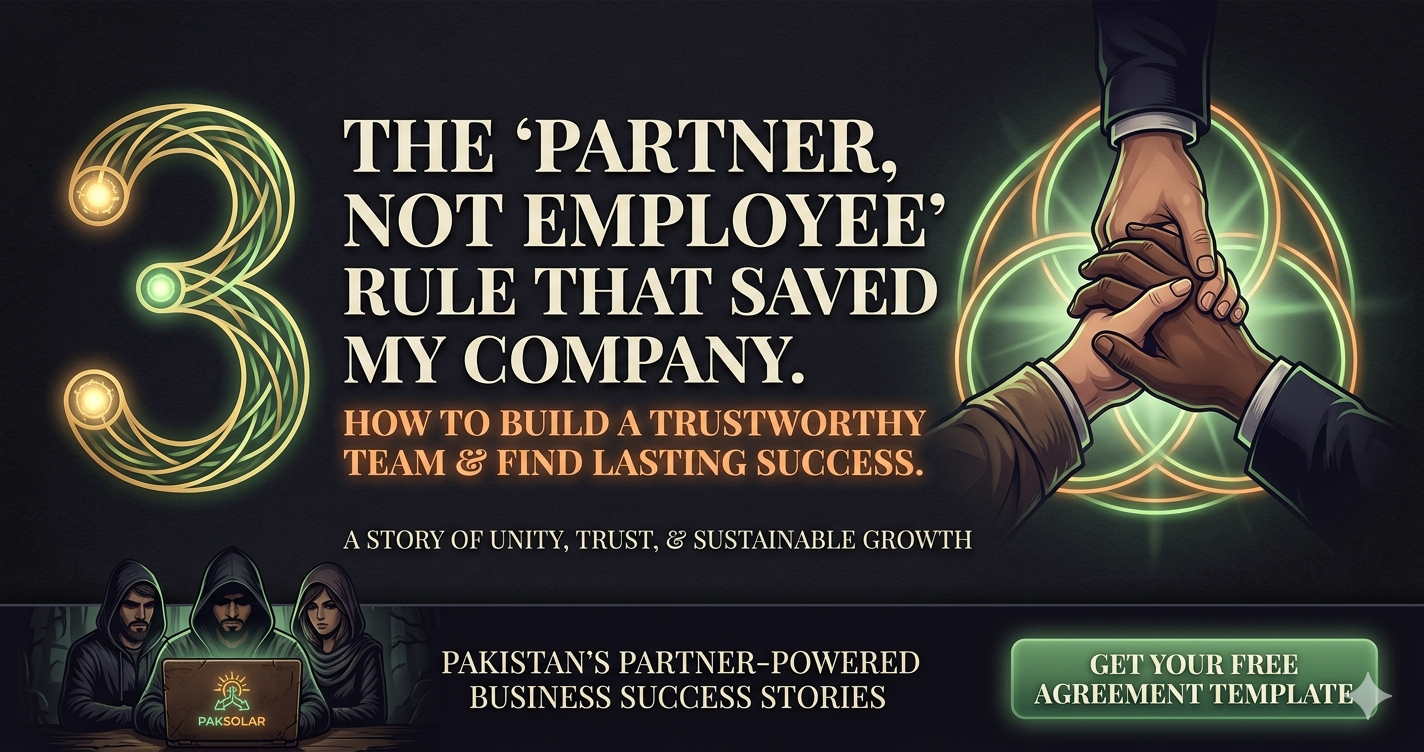
Target Keyword: how to build a trustworthy team
Secondary Keywords: business partnership rules, hiring philosophy for small business, solar company success story pakistan
Word Count: 1,800
Read Time: 8 minutes
INTRODUCTION
I almost lost everything in 2014.
Not money. Not customers. Trust.
I was running three solar companies as a business consultant. I had built their systems, trained their teams, created their branding. And within 12 months of launch, every single one of them started doing exactly what I hated: misleading customers, selling oversized systems, disappearing after installation.
Why? Because they hired employees. And employees, no matter how good, eventually follow incentives. Salespeople need commissions. Managers need targets. Owners need profits. Customers become numbers.
I remember sitting in my office in Karachi after a customer called me crying. She had spent 1.2 million rupees on a system that never worked properly. The company that sold it to her stopped answering calls. She asked me: “Why do all solar companies become the same?”
I didn’t have an answer. Because I knew her installer. I had trained him.
That night, I decided something had to change. If I ever started my own company, I would never hire employees. I would only take partners.
In 2015, I started PAKSOLAR. Six months later, I found two people willing to join as workers, not partners, but I decided to make them parterns. Everyone told me it would fail. Three partners? In Pakistan? Never works.
That was 11 years ago. We’re still together. Still partners. Still honest.
Let me tell you how.
THE TRUTH: Employees Serve Incentives. Partners Serve Purpose.
Here’s what most business advice won’t tell you about hiring:
The moment you hire an employee, you create an adversarial relationship.
You want quality. They want salary. You want customer satisfaction. They want to go home on time. You want honest advice. They tell you what you want to hear.
I’m not blaming employees. It’s human nature. When someone can be fired, they protect themselves first. Customers come second.
The hard truth I learned: No amount of training, bonuses, or “company culture” speeches changes this. Only ownership changes this.
Let me show you what I mean with a real example.
The Salesperson Problem
Most solar companies hire salespeople on commission. The structure:
- Base salary: Low
- Commission: High (% of system size)
- Target: Monthly sales quota
What does this incentivize?
- Sell the biggest system possible, even if customer doesn’t need it
- Promise anything to close the deal
- Disappear after commission is paid
I’ve seen salespeople sell 15kW systems to homes that need 5kW. The customer overpays by 300,000 rupees. The salesperson makes 30,000 extra commission. The company gets higher revenue. Only the customer loses.
And when the customer calls with problems? Salesperson says: “Talk to technical team.” Technical team says: “Talk to customer support.” Customer support says: “We’ll call you back.” They never call back.
This is not bad people. This is bad structure.
The Partner Solution
When someone is a partner:
- They share profit, not just salary
- Reputation damage affects them directly
- They have authority to solve problems without asking permission
- They stay for years, not months
My two partners and I have equal say. No one is “the boss.” If a customer has a problem, any of us can authorize a free visit, replacement part, or refund. We don’t need approval. We don’t have to “check with management.”
When a customer calls me at 10 PM because their inverter is beeping — I answer. Not because I have to. Because I’m a partner. The company’s reputation is my reputation.
HERE’S WHAT ACTUALLY WORKS: The 5 Rules of Partner-Based Business
Let me share exactly how we built a 3-person partnership that has lasted 11 years — against all advice.
Rule #1: No Employees in Customer-Facing Roles
We have staff for warehouse, logistics, and accounting. But anyone who talks to a customer is a partner.
What this means:
- When you call PAKSOLAR, an owner answers
- When we design your system, an owner does the calculation
- When we install, an owner is on site
- When something breaks, an owner comes to fix it
Cost of this rule: We grow slower. We can’t take 50 customers per month. We take 10-15 and do them perfectly.
Benefit of this rule: Every customer gets the same care. No “bad batch” of installs. No sales lies. No disappearing after payment.
Rule #2: Partners Have Equal Equity, Equal Voice
Most partnerships fail because one person owns 51% and makes all decisions. The other partners feel like employees with a fancy title.
Our structure: Equal equity. Equal profit share. One person, one vote.
If two partners disagree, the third decides. If all three disagree, we don’t do it. No exceptions.
Example: Two years ago, a large builder offered us a contract worth 8 crore rupees. Huge project. My two partners wanted to take it. I refused because the payment terms were 180 days. We debated for a week. Couldn’t reach agreement. We declined the project.
Did we lose money? Yes. Short-term.
Did we avoid a cash flow crisis that would have destroyed us? Absolutely. Six months later, that builder delayed payments to every vendor. We would have been ruined.
Equal voice saved us.
Rule #3: No Individual Sales Targets
This is the rule that separates us from every other solar company in Pakistan.
We have no sales targets. None. Zero.
Not weekly. Not monthly. Not yearly.
If a customer is not a good fit for solar, we tell them. If they need a smaller system than they asked for, we tell them. If their roof is too shaded, we tell them not to buy.
How do we grow? Repeat customers and referrals. That’s it. A happy customer tells 3-5 people. A cheated customer tells everyone.
In 11 years, we have never advertised. Not once. Every customer came from:
- Previous customer referral
- Someone reading my blog or social media
- A friend who saw our work
Rule #4: Partners Must Complement, Not Compete
Here’s who my two partners are:
| Partner | Role | Strength |
|---|---|---|
| Partner A | Technical operations | Can fix any inverter, design any system |
| Partner B | Project management | Handles logistics, teams, site visits |
| Me (KARCrush) | Customer facing + strategy | Educates customers, writes guides, business decisions |
Notice: None of us does the same job. We don’t compete. We fit together like puzzle pieces.
When you’re hiring a partner, don’t look for someone like you. Look for someone who covers your weakness.
Rule #5: The “No Surprise” Communication Rule
We have one non-negotiable rule: No surprises.
If a partner makes a mistake — wrong equipment ordered, customer complaint, missed deadline — they must tell the other two within 24 hours. No hiding. No fixing it silently. No blaming someone else.
Why this matters: Small problems hidden become big problems exposed. When a customer is angry because of a delay, we all know why. We don’t guess. We don’t make excuses. We fix it together.
How we enforce it: We have a WhatsApp group. Every night, each partner sends three things:
- What went well today
- What went wrong today
- What needs attention tomorrow
This takes 2 minutes. It has saved us from dozens of disasters.
REAL EXAMPLE: When Trust Was Tested
Three years ago, one of my partners made a mistake that could have destroyed us.
He approved a system design for a commercial client without checking the roof structure. After installation, the roof developed cracks. The client threatened legal action. Repair cost was estimated at 450,000 rupees.
My partner told me and the other partner the same day. No hiding. No excuses. He said: “This is my fault. I should have sent a structural engineer before approval.”
What happened next:
We didn’t fire him. We didn’t deduct from his share. We didn’t publicly blame him.
We paid for the repairs from company profit (not his personal share). We visited the client together — all three partners — and apologized. We offered a 3-year free maintenance extension. The client stayed with us and later gave us two more projects.
Why didn’t we punish him? Because partners don’t punish partners. We solve problems together. If we had fired him or cut his share, the message would be: “Hide your mistakes.” That message destroys companies.
Today, that partner is more careful than anyone. He personally checks every roof now. The lesson stuck because trust was honored, not broken.
COMMON MISTAKES
Mistake #1: Making Someone a Partner Too Early
I waited 6 months before offering partnership. I needed to see:
- Do they care about customers when I’m not watching?
- Do they admit mistakes?
- Do they work when no one is supervising?
Minimum trial period: 6 months. Ideally 1 year.
Mistake #2: No Written Partnership Agreement
We have a 12-page agreement. It covers:
- What happens if someone wants to leave
- What happens if someone dies
- How disputes are resolved
- Non-compete clauses
- Profit distribution formula
You will never need this until you desperately need it. Write it before you start.
Mistake #3: Not Meeting Regularly Without Customers
We meet every Friday at 9 AM. No customers. No phones. Just the three of us discussing the business.
Topics: What’s bothering us? What’s unfair? What’s someone not saying?
Most partnerships fail because small resentments grow into big walls. Weekly meetings clear the air.
FAQs
Q: Can this work for non-solar businesses?
A: Yes. Any service business where trust matters — real estate, auto repair, medical clinics, consulting. The principle is the same: owners serve customers better than employees.
Q: What if I can’t find partners?
A: Start solo. Do everything yourself. Grow slowly. When you find someone who shares your values, bring them in. Don’t force partnerships with the wrong people.
Q: How do you split profit equally if one partner works more hours?
A: We track hours roughly. If someone consistently works much less, we discuss it. But in 11 years, it has balanced out. Some months I work less (family reasons). Some months they work less. We are not robots.
Q: Would you ever hire employees?
A: Yes, but never in customer-facing roles. Warehouse, delivery, cleaning — those can be employees. Anyone who talks to customers must be an owner. That’s non-negotiable.
YOUR ACTION STEP
If you own a small business or are starting one:
- List every customer-facing role in your business
- Ask honestly: Is the person in that role acting like an owner or an employee?
- For the next 30 days, answer every customer call yourself — no transfers, no excuses
- Start looking for one potential partner, not five employees
CLOSING
People told me three partners would never work.
They said we would fight. We would break up. One would cheat the others.
Eleven years later, we are not just business partners. We are friends. I trust them with my reputation, my customers, and my family’s financial future.
Not because we are special. Because we built a system where trust is the only option.
You can do this too. Not with 50 employees. With 2-3 real partners who care as much as you do.
That’s the team you can trust. That’s PAKSOLAR.
*If you’re building a business and want advice on finding partners, WhatsApp me. I respond to every message. +9203482436646*

![INTRODUCTION My first blog post got 11 visitors. Seven were me (checking from different devices). Two were my wife. One was my partner. And one was a random person from India who clicked a wrong link. I thought I had failed. I had read all the get 100,000 visitors in 30 days articles. I had implemented their advice beautiful images, perfect formatting, social media sharing buttons, email popups. Nothing worked. Then I realized something embarrassing I was trying to get traffic from people who didn't know I existed. You can't drive traffic to a blog that no one knows about. That's like trying to drive customers to a shop in a desert. So I stopped following the gurus. I stopped obsessing over viral strategies. I stopped tweeting my posts into the void. And I did one thing that actually worked. Within 90 days, I crossed 1,000 monthly visitors. Within 6 months, 5,000. Today, I average 15,000+ per month. Here's exactly what I did — and what you can copy starting today. THE TRUTH No One Cares About Your Blog Until You Give Them a Reason Here's what the traffic gurus won't tell you The internet is already full of content. Millions of new blog posts every day. Yours is invisible until you put it in front of someone who has a specific problem. Build it and they will come is a movie quote. Not a marketing strategy. The hard truth For your first 1,000 visitors, you cannot rely on Google. Your blog is too new. Google doesn't trust you yet. You need to go where your readers already are. Not to sell. To help. Let me show you exactly how. HERE'S WHAT ACTUALLY WORKS The 3-Channel Strategy I tried 12 different traffic methods. Only 3 worked for the first 1,000 visitors. Here they are. Channel #1 Answer Questions Where Questions Are Being Asked (40% of first 1,000 visitors) This was my #1 source of early traffic. The method Find people asking questions in your niche. Answer them helpfully. Include a link to your blog post that answers the question more thoroughly. Where to find questions Platform What Works What to Avoid Facebook Groups Niche groups (solar Pakistan, SEO beginners, etc.) Posting links without answering first Reddit Subreddits like rPakistan, rsolar, rBlogging Self-promotion without value Quora Questions with 500-5,000 views (not too popular, not dead) Copy-pasting same answer everywhere WhatsApp groups Your own network, industry groups Spamming (ask permission first) Real example from my blog I found a Facebook post in a Pakistan solar group. A customer wrote My on-grid solar stops working during load shedding. Is my system defective I replied Your system is not defective. On-grid systems are designed to shut down during grid failure for safety (anti-islanding). Here's a detailed guide I wrote explaining why and what you can do instead [link] That one reply Helped the original poster Got 23 likes and 8 comments 5 other people messaged me privately with questions 3 of them became blog readers 1 became a PAKSOLAR customer The key Answer first. Add value. Then share the link as more detail, not as the main answer. Do not Post just the link with read this. That's spam. Channel #2 Write One Post That Solves One Specific Problem for One Specific Person (30% of first 1,000 visitors) Early on, I was writing Ultimate Guides. 3,000 words. Everything about solar. Overwhelming. No one read them. The shift I started writing for one person with one problem. Bad title (too broad) Complete Guide to Solar Energy Good title (specific) Why Your Solar Inverter Shows 'Battery Low' at 80% (And What to Do) Why this works When someone searches that exact problem, they find your post. They don't care that your blog is new. They care that you solved their problem. My process for finding specific problems Go to Facebook groups Reddit in your niche Sort by new (not popular) Find questions that are unanswered or poorly answered Write a post answering that exact question Go back and reply to the original question with your link Example from my blog Someone asked My solar panels are generating only 30% of rated power. Installer says normal. Is that true I wrote a 1,200-word post explaining temperature losses, dust factor, and wiring losses. Included actual calculation. Showed why 70-80% of rated power is normal for Karachi summers. That post now ranks on Google first page for solar panel low generation problem. But early on I got traffic from sharing the link back to the person who asked. They thanked me. Others saw the answer. They visited too. Channel #3 Email Your Network (20% of first 1,000 visitors) This is obvious but most people skip it because it feels awkward. Your personal network includes Friends and family (10-50 people) Former colleagues (20-100 people) Existing customers (if you have any) LinkedIn connections (100-500 people) I sent a simple email Hey [name], I started a blog sharing what I've learned about solar (and sometimes SEObusiness). If you're ever curious about how solar actually works — without the sales pitch — you might find it useful. Here's the link dotcrush.com. If not, ignore this. No hard feelings. - K Results from 47 emails 22 visited the blog 9 subscribed 3 shared a post with someone else 0 unsubscribed (because I only emailed once) The key Send one email. Not weekly. Not monthly. One. Ask for nothing except a visit. What Did NOT Work for First 1,000 Visitors (So You Don't Waste Time) Let me save you months of frustration. Strategy Why It Failed TwitterX No organic reach without existing followers Instagram SolarSEO content doesn't perform well there (visual platforms need different content) SEO (organically) Google sandbox for new sites = 4-6 months before ranking Pinterest Wrong audience for technical content Paid ads Too expensive for 1,000 visitors ($200-500) Blog commenting Spammy, low quality, no real traffic Medium republishing Duplicate content risk, low conversion to your domain Focus only on the 3 channels above until you hit 1,000 monthly visitors. Then expand. REAL EXAMPLE My First 1,000 Visitors Breakdown Here's exactly what my traffic looked like the month I crossed 1,000 visitors. Month 6 (crossed 1,004 visitors) Source Visitors What I Did Facebook Groups 412 Answered 15-20 questions per week Direct (links from my answers) 287 People clicked from Quora, Reddit, WhatsApp Google Search 189 Some posts finally ranking on page 2-3 Email (my one blast) 68 47 emails sent, 68 visits (people forwarded) Referral (others sharing) 48 People who liked my answers shared Total 1,004 — Time taken 6 months Posts published 14 Hours spent helping on FacebookReddit ~3 hours per week Money spent on promotion 0 rupees The key insight 700 of my first 1,000 visitors came from me going to where readers already were and helping them. Not waiting for Google to find me. COMMON MISTAKES Mistake #1 Posting Links Without Context Bad Check out my new blog post [link] Good Great question. Here's what I've learned about this. [2-3 sentences of actual answer]. I wrote a detailed guide with examples here if you want to read more [link] Mistake #2 Giving Up After 3 Months Most blogs fail because people stop publishing after 8-10 posts. They expect traffic. It doesn't come. They quit. What I did Committed to 6 months with zero expectations. After 6 months, I evaluated. Not before. Mistake #3 Writing What You Want, Not What People Are Asking I wanted to write about future of renewable energy in Pakistan. No one was searching for that. No one was asking that in groups. What I do now I write what people are asking today. The future post can wait until I have an audience. FAQs Q How many posts should I publish before expecting traffic A At least 15-20. My first 5 posts got almost no traffic. Posts 10-15 started getting small trickles. Posts 15-20 is when Google started noticing. Q Should I focus on one niche or write about multiple A One niche until you hit 5,000 monthly visitors. My blog is solar + business + SEO — but that's three related niches (all helping people solve problems). Don't mix solar with cooking or fashion. Q How long should each post be for a new blog A Minimum 1,200 words. Maximum 2,500. Shorter won't rank. Longer takes too long to write when you need volume. Q Do I need a newsletter from day one A Yes. Setup is free (Mailchimp has a free tier up to 500 subscribers). Add a simple form Get new posts by email. Don't offer lead magnets yet. Just collect emails. YOUR ACTION STEP This week, do these four things Join 3 Facebook groups in your niche. Read for 2 days before commenting. Find 5 unanswered questions in those groups. Answer each with 2-3 helpful sentences. Write one blog post answering the most common question you saw. Send one email to 20-30 people you know, sharing your blog. Keep it humble. That's it. Do this every week for 60 days. You will hit 1,000 visitors. Download my free 90-Day First 1,000 Visitors Tracker (spreadsheet to track your questions answered, posts published, and traffic sources) [Link to lead magnet PDF] CLOSING You don't need a massive budget. You don't need thousands of followers. You don't need to be an SEO expert. You need to help real people with real problems. One answer at a time. One post at a time. My first visitor was my wife. My 1,000th visitor was a stranger from Lahore who found my Facebook answer about solar inverters. He later became a customer. Then a friend. Then someone who sent me three referrals. That's how it grows. Slowly. One person at a time. Start today. Don't wait for your blog to be ready. It will never feel ready. Just publish. Then help. Then repeat.](https://www.dotcrush.com/wp-content/uploads/2026/04/My-first-blog-post-got-11-visitors-150x150.png)