I lost my blog to hackers and my peace to failure. Twice, I had to rebuild from nothing. The shift that saved me wasn’t motivation — it was something much quieter.
Most people who write about mindset have never actually had their life fall apart. They’ve read about resilience in a book and dressed it up with a sunrise metaphor.
That’s not what this is.
I’m writing this because I’ve genuinely lost everything worth losing — twice — and the thing that pulled me through both times wasn’t hope, wasn’t hustle, and definitely wasn’t some inspirational quote I found on Instagram. It was a single, quiet shift in how I see my own life. And it took me almost 40 years to find it.
If you’re reading this and you’re in the middle of your own collapse — a business that failed, a career that vanished, a project you poured years into that suddenly disappeared — I’m not going to tell you everything happens for a reason. I hate that phrase. It’s lazy comfort.
I’m going to tell you what actually changed for me.
The First Time I Lost Everything
The first collapse came slowly, then all at once. I had co-founded a solar company, built it over years, designed systems I was genuinely proud of, and assembled a team I thought would last. And then — due to circumstances I couldn’t control and decisions I should have seen coming — it was gone.
I don’t mean “gone” as in a bad quarter. I mean: the company I built didn’t exist anymore. The team scattered. The years of effort had no physical evidence left except some old project photos and a few files on a hard drive.
I remember sitting in my room, staring at the wall, and feeling something I’d never felt before: irrelevance. Like the world had moved on and my name wasn’t on any list anymore. Everything I’d identified myself by — founder, consultant, solar expert — suddenly felt like a costume I wasn’t allowed to wear.
I won’t pretend I handled it gracefully. I didn’t. I replayed every mistake. I imagined what people who knew me were saying. I compared my invisible present to everyone else’s visible success. It was a full-time job in self-destruction.
The Second Time I Lost Everything
Years later, I had rebuilt. I was blogging again. I had readers, traffic, a growing body of work. I was genuinely proud of what I’d created — hundreds of posts, years of thinking out loud, a small but real audience that trusted me.
Then a hacker found a vulnerability I hadn’t patched, and in less time than it takes to drink a cup of tea, everything was gone. Posts. SEO rankings. Comments. Years of my life, deleted.
I stared at a blank WordPress install screen. Again. Just like after the business. Just like the first time I’d felt erased. The irony wasn’t lost on me: I had now lost two entirely different lives I’d built — one in solar, one in blogging — and neither one showed any mercy.
But this time, something was different. I didn’t sink into the same hole. It hurt, deeply. I was furious, sad, exhausted. But I didn’t question whether I should start again. I just did.
That’s when I realized something had shifted in me between the first collapse and the second — and if I could name it, maybe it would help someone else.
The Mindset I Had Before (And Why It Failed)
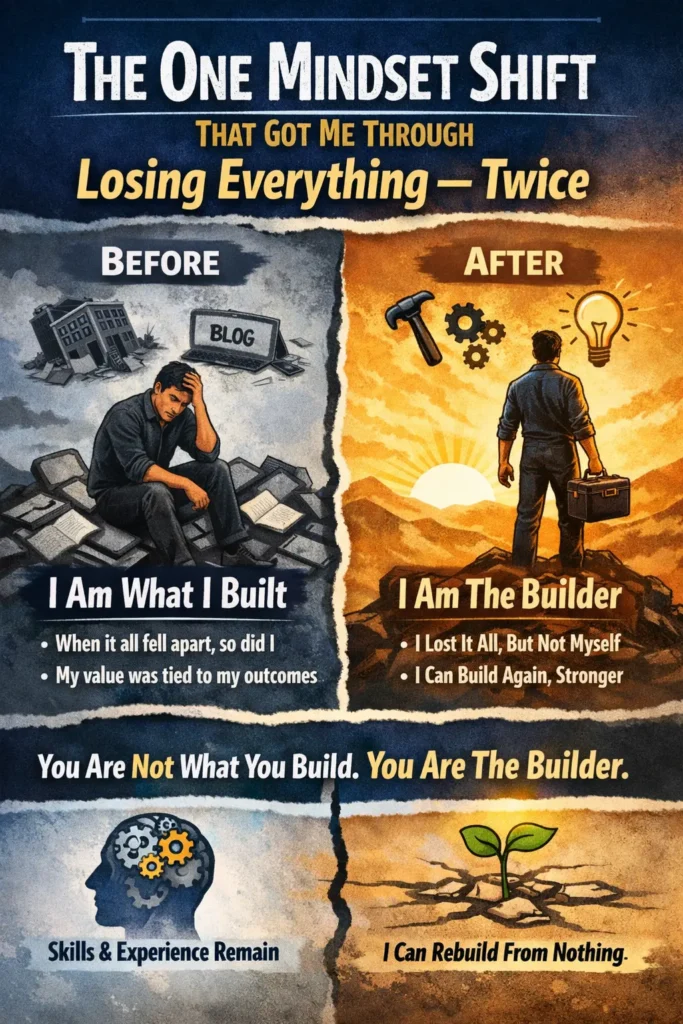
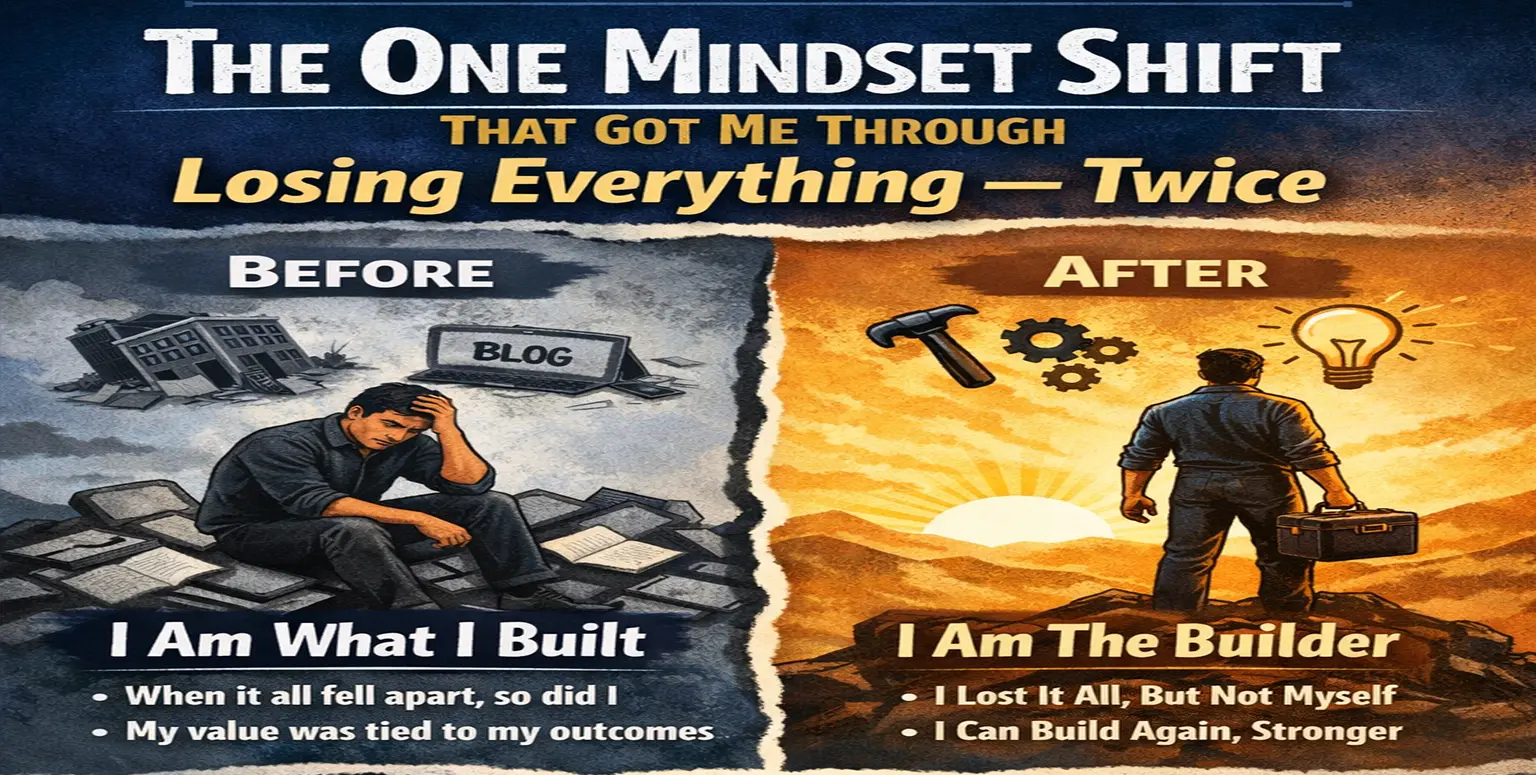
Before the first collapse, I believed a very common, very dangerous thing: my value was equal to what I had built.
If the company was doing well, I mattered. If the blog had traffic, I was legitimate. My sense of self was bolted onto external outcomes. And when those outcomes were ripped away, so was my identity. There was no “me” underneath the rubble — just rubble.
This is why I spiraled so hard after the first loss. Not because I missed the money or the title, but because I didn’t know who I was without them. I had never met that person. And I was terrified of him.
The Shift: You Are Not What You Build. You Are the Builder.
This sounds simple. It’s not. It took me years and two complete erasures to actually feel it in my bones instead of just thinking it in my head.
Here’s what the shift looks like in practice:
Before the shift: If my blog gets hacked and I lose all my posts, I’ve lost my work. My work is me. Therefore, I’m lost.
After the shift: If my blog gets hacked and I lose all my posts, I’ve lost output. But the thing that produced that output — my mind, my experience, my voice — is still here. Unharmed. Ready.
The builder is intact. The builder can build again.
This isn’t some detached, “just think positive” nonsense. I’m not telling you to smile through bankruptcy. I’m telling you that after losing a solar company, I still knew how to design solar systems. After losing a blog, I still knew how to write posts that people read. The skill, the judgment, the instincts — none of that was in the database. It was in me. It was me.
The hacker deleted my content but he couldn’t delete my hands. The business failure emptied my bank account but it couldn’t empty my capability.
Once I truly understood this, everything changed. Not because life stopped being painful, but because pain no longer erased my identity.
What This Shift Doesn’t Mean
Let me be clear about what I’m not saying, because mindset advice is full of half-truths that make people feel worse.
I’m not saying you shouldn’t grieve what you lost. You should. I did. Grief is human. When I lost the blog, I mourned specific posts — ones where readers had written to me saying “this changed how I think.” Those conversations were real. Losing them hurt.
I’m not saying external outcomes don’t matter. They do. Bills exist. Reputations exist. I’m not pretending a bankruptcy and a fresh start feel the same. They don’t.
I’m not saying you should detach from everything you build. Care deeply. Pour yourself into your work. That passion is what makes you good at what you do. The shift isn’t about caring less. It’s about knowing that even if what you build gets demolished, the part of you that built it is still standing.
How to Practice This (Before You Need It)
The worst time to learn this mindset is during a crisis. The best time is now, while things are stable, so it’s already in your bones when the ground shakes.
Here’s what I do, and what I’d suggest to anyone:
1. Separate Your Output From Your Identity — On Paper
Write two lists. List one: “What I’ve built.” (Your business, your blog, your career, your projects.) List two: “What I know how to do.” (The skills, instincts, and judgment that created list one.)
Now imagine list one disappearing tomorrow. Seriously. Visualize it. What’s left? List two. That list is yours permanently. Nobody can delete it. Nobody can fire you from it. You take it everywhere.
This exercise felt silly the first time I did it. Now I revisit it whenever I feel my identity wrapping too tightly around a project.
2. Prove to Yourself You Can Rebuild
After the hack, I didn’t just tell myself I could rebuild — I made myself do it publicly. The $0 traffic experiment I wrote about wasn’t just for readers. It was for me. I needed evidence that the builder was still working.
If you’ve never rebuilt from scratch, do it as a small experiment now. Delete a draft and rewrite it better. Design a small system from zero without using old templates. Prove to yourself that your ability isn’t locked in your past output.
3. When You Meet Someone New, Don’t Lead With What You Built
This is a subtle practice but a powerful one. When someone asks what you do, try describing what you know instead of what you own or run. Instead of “I run a solar company,” say “I design solar systems — I’ve been doing it for 15 years.” Instead of “I have a blog with X visitors,” say “I write about SEO from real experience.”
The first version is tied to an outcome that could disappear. The second is tied to you. Practice living in the second version.
What Actually Got Me Through the Second Time
When I sat in front of that empty WordPress screen the second time, I didn’t cry. I didn’t have the same hollowed-out feeling I’d had years earlier. I felt angry, yes. Tired, absolutely. But underneath it, there was something solid: I know how to do this. I’ve done it before. I’ll do it again.
That voice wasn’t confidence. It wasn’t motivation. It was identity — finally in the right place.
The posts I’ve written since the hack are some of the best I’ve ever produced. Not because I’m more talented now, but because I’m no longer terrified of losing them. I know if they vanished tomorrow, I could write new ones. Maybe better ones. The builder is fine.
If you take nothing else from this: you’ve probably built something before. That means you’re a builder. And builders — real ones — don’t stop being builders just because the last building fell down.
One more thing: If you’ve ever had to build a team that lasts — and you know how hard that is when everything feels temporary — I wrote about the practical side of that too. How to Build a Team You Can Actually Trust picks up exactly where this leaves off.
Crush your next move — not by clinging to what you built yesterday, but by remembering who built it.